
CHARGING EXPLAINED
AC vs DC charging: which approach fits your location?
Published · Updated 27 October 2026 · Vasudha editorial
AC and DC describe how power is delivered to the vehicle. The useful choice depends on vehicle compatibility, time parked, energy needed and site capacity—not simply the largest advertised charger rating.
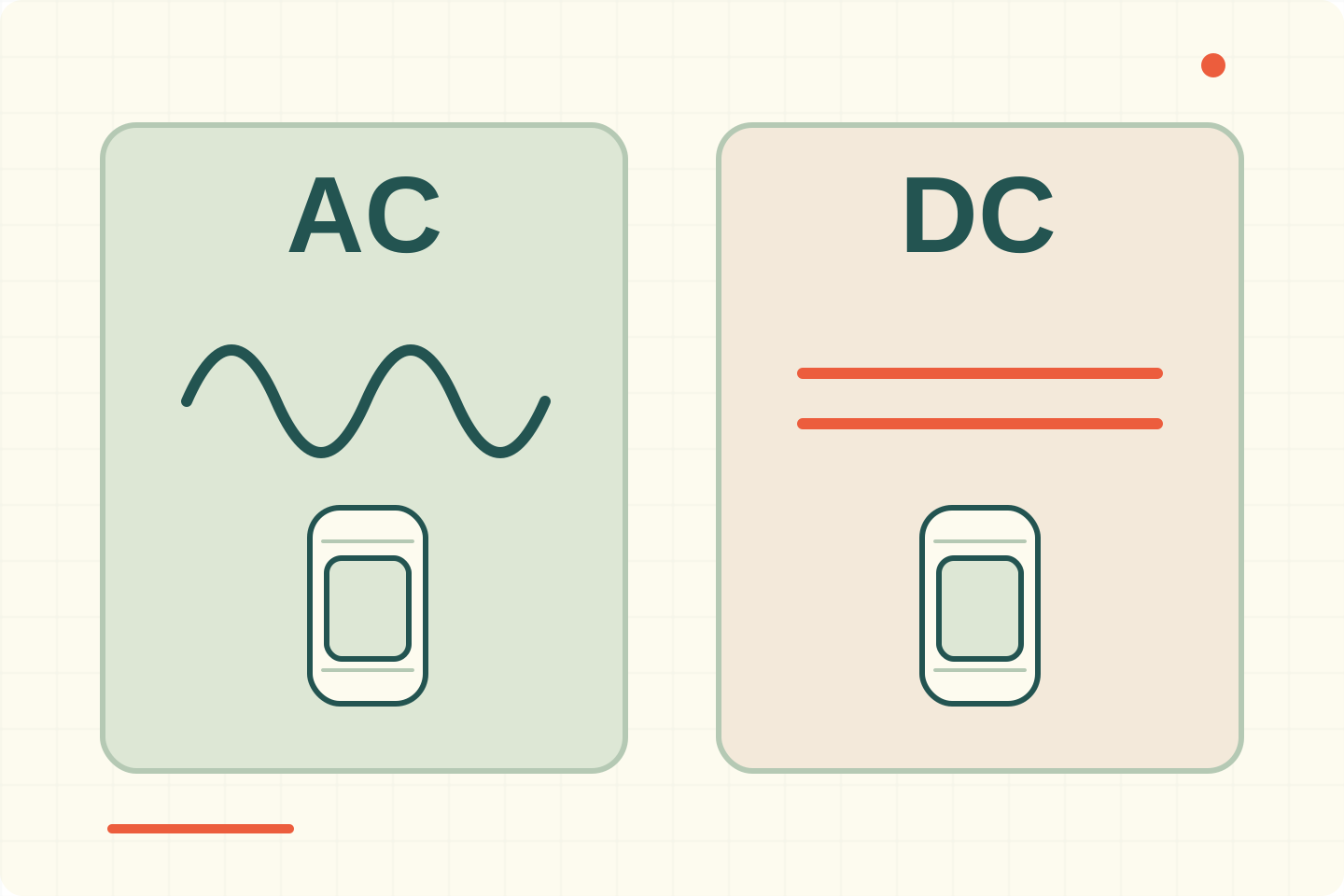
What the difference means
With AC charging, the vehicle's onboard charger converts alternating current to the direct current used by its battery. A DC charger performs this conversion outside the vehicle. Actual charging is limited by the vehicle, equipment and conditions; the number on the cabinet is not a promise of the power every vehicle will receive.
Match the dwell time
Long-stay parking can create an opportunity to replenish energy over several hours. Shorter turnaround windows may lead to a discussion about DC equipment. Neither approach is automatically right for every office, hotel or depot. Begin with the vehicle's charging capability and the energy required before its next journey.
Compare the whole installation
Different equipment can create different supply, distribution, footprint and maintenance requirements. Check cable routes, access and electrical capacity alongside the hardware cost. A more powerful unit can require substantial enabling work. A less powerful arrangement can also be unsuitable if it cannot meet the operational charging window.
An illustrative decision
A hotel with overnight visitors and a fleet depot with timed shift changes should not use the same assumptions. The hotel may explore AC for long stays; the depot should model vehicle readiness against its schedule. These are discussion examples, not equipment recommendations. Confirm vehicle compatibility and site conditions before selection.

Questions to bring to the discussion
What vehicles will use the charger? How much energy is needed? How long are they parked? How many must charge together? What can the existing connection support? The NITI Aayog charging-infrastructure handbook explains the broader technology and planning context. Final selection requires equipment documentation and a site-specific assessment.
Look at energy and time together
Energy needed before the next departure is more useful than a headline rating. A driver arriving with a partly charged battery and parking overnight differs from a vehicle returning between shifts. Use representative arrival and departure patterns. Any charging-time calculation must account for vehicle acceptance, equipment performance and operating conditions rather than assume a constant maximum rate.
Think about more than the connector
A matching connector is one part of compatibility. The supported charging method, vehicle acceptance limits and equipment documentation matter too. At a shared site, consider the likely mix of vehicles rather than one example. If network access, authentication or payment is required, establish those interfaces separately so physical compatibility is not confused with a complete user experience.
Choose an approach you can operate
Ask who will manage access, assist users and coordinate faults. Review space, service access, warranty conditions and expansion. It can be useful to compare more than one scenario, with each based on the same vehicle needs. Bring these needs to the discussion so equipment selection becomes part of a considered project rather than the first irreversible decision.
Bring the questions to your site.
Tell us what you are planning. We can identify a useful starting point for the infrastructure discussion.