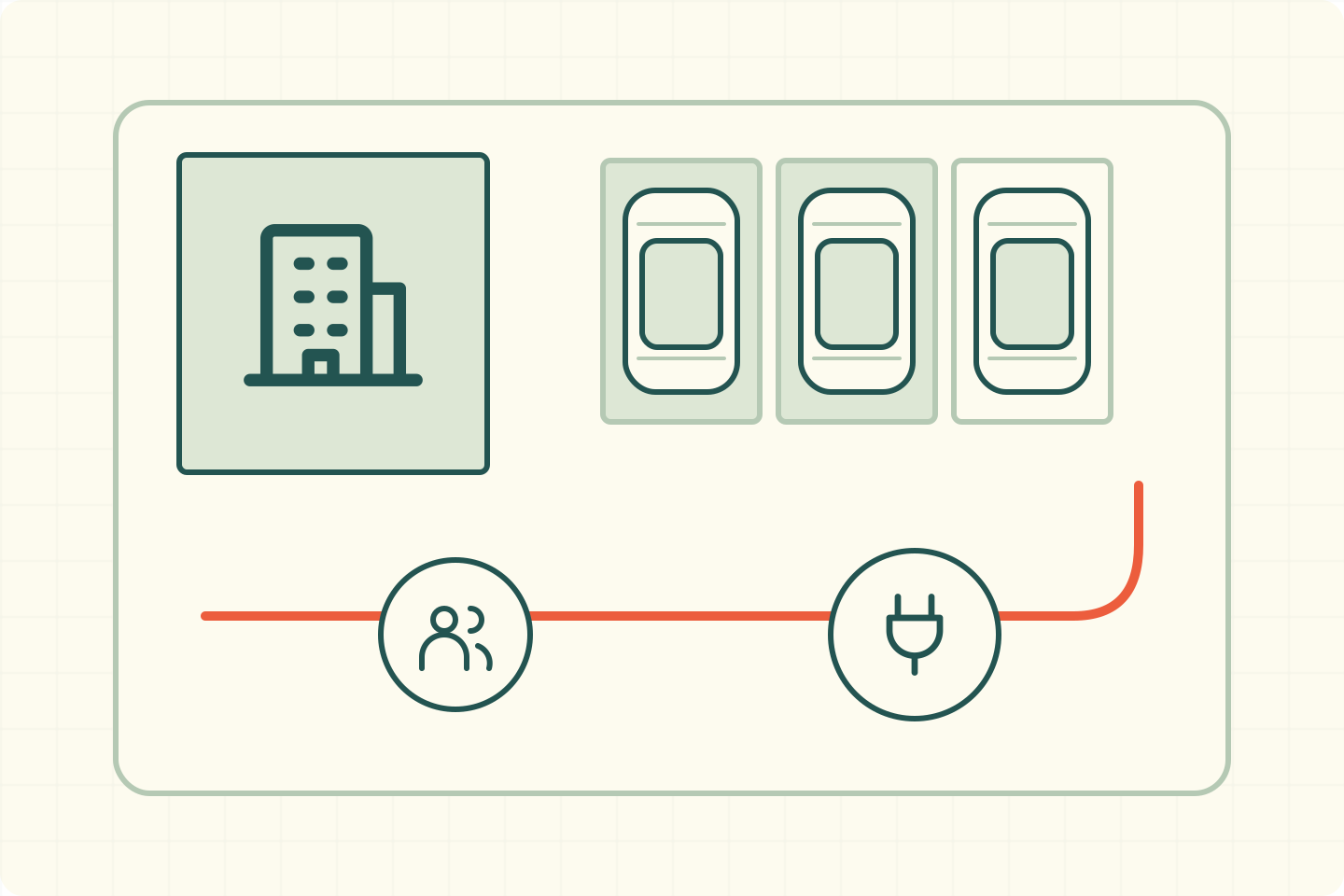
Visitor turnover and all-day employee parking can exist in the same building. Choosing one charging arrangement for both without checking demand can waste useful capacity.
WHAT TO THINK THROUGH
A more useful project brief.
These considerations help shape a site discussion; technical suitability needs assessment.
Conceptual planning graphic
01
Match charging to the parking pattern
Separate all-day staff parking from customer visits and other short stays. Discuss expected EV demand, access rules and how bays will be allocated when more people want to charge. An arrangement is easier to manage when the equipment choice and everyday parking policy are considered together.
02
Fit the work around the property
Cable routes, equipment placement and installation windows need coordination with tenants, visitors and the facility team. Identify restrictions in basements, common areas or operating hours early. Agree who handles access, signs, fault reports and communication with building users after the facility is available.
03
Compare a complete, grounded scope
Review equipment, electrical works, civil preparation and ongoing responsibilities as separate parts of the proposal. Decide whether charging is an amenity, a managed service or a public-access business before making revenue assumptions. A phased plan can be explored where current demand is limited and future growth needs consideration.
HOW VASUDHA CAN HELP
Connect the need to the infrastructure.
Discuss site planning, charger installation, supporting electrical works and maintenance needs. Equipment, commissioning responsibilities and service availability are confirmed against your location and scope.
Start with the vehicles that will use the site, how long they normally park and how much charging they need before the next journey. Then review compatibility, the number charging together and the available electrical capacity. AC and DC can suit different patterns; a larger advertised rating is not automatically better. Share the location, vehicle use and parking arrangement so the discussion can begin with the site.
What affects the installation cost?
The cost includes more than the charger. Equipment type and quantity, supply upgrades, cable distance, distribution and protection, mounting or foundations, site preparation and service arrangements affect the scope. Ask for a quotation identifying inclusions, exclusions and work expected from other parties. A location, parking plan and intended use provide the starting point for a meaningful discussion.
Which locations does Vasudha cover?
Vasudha is based in Mumbai, Maharashtra. Share the project location, expected scope and access requirements so availability and execution needs can be discussed. For multiple locations, a site list and proposed sequence create a useful conversation. Coverage is confirmed for the actual project.
PUT THE REQUIREMENT IN CONTEXT
One property can have more than one charging need.
An office complex may have staff vehicles parked throughout the day and visitors stopping for a meeting. A retail destination may see a changing mix of short and longer stays. Begin by separating those patterns, then discuss access, bay allocation and the existing supply. The useful question is how charging can work within the property, rather than how many identical chargers can fit in the car park.
Questions worth answering early
Who will use the facility: employees, tenants, visitors or the general public?
How long do those vehicles normally remain parked?
Who can approve the electrical and common-area work?
Who will manage access and coordinate maintenance after installation?
Send the location, parking layout and the user groups you want to serve. Available electrical drawings and a facility contact help us discuss what needs to be assessed next.
FROM POSSIBILITY TO POWER
Your next EV charging project starts with a conversation.
One site or multiple locations. An early idea or a defined requirement. Tell us what you’re planning.